Books
In Dharma: Hinduism and Religions in India, Badrinath argues that the Indian civilization is a 'Dharmic' one, founded as it is on the principle of dharma. Dharma has always been translated, wrongly, as 'religion'.
The concerns of Indian philosophy are the concerns of human life everywhere. Badrinath talks about the history of the words 'Hindu' and 'Hinduism', Islam in relation with Hinduism, the issues that arose from the spread of Christianity in India, Jainism and Buddhism as part of dharma and darshana, and explains why organized violence in the service of religious fundamentalism is the very negation of religion with its reverence for life.
Thought provoking, perceptive and challenging many long-held notions, Dharma is a must-read for anyone who is interested in India, the interaction of different religions over centuries in this land, and the underlying unity of all life.
This book brings together a series of short essays by Chaturvedi Badrinath on diverse topics related to Indian philosophy and thought. Drawing mainly from the Mahabharata, the Upanishads, and the Yoga-vasishtha, Badrinath explores the concept of dharma, central to any understanding of the Indian civilization.
The book engages the ordinary reader, who is perhaps unacquainted with formal philosophy, but is in search of meaning in the midst of the pressures of modern life. The moral dilemmas faced by human beings today are not new. In a world increasingly filled with fear, violence, and terrorism, ordinary people seek ways in which to order their lives. An understanding of the foundations of human liberty, happiness, self and the other, self-interest, the basis of fear, and a movement towards freedom or moksha are essential to that quest. Badrinath had an entirely original approach to the six darsanas or world views.
In the essays, he has rendered the most sophisticated ideas in language that is simple and accessible. His thoughts were crystallized over a life spent in deep reflection and engagement with Eastern and Western philosophies. In his writing, the most ancient philosophy is shown to have immediate relevance to modern times.
In the stories where the Mahabharata speaks of life, women occupy a central place. In living what life brings to them, the women of the Mahabharata show, that the truth in which one must live, is however, not a simple thing; nor can there be any one absolute statement about it. Each one of them, in her own way, is a teacher to mankind as to what truth and goodness in their many dimensions are.
The twelve women of the Mahabharata whose life stories make up this book, range from Shakuntala, Savitri and Damayanti who are known only in sketches; from Sulabha, Suvarchala, Uttara Disha, Madhavi and Kapoti who are hardly known, and finally to Draupadi, known widely but frozen in popular culture and writing in two or three standard clichéd images.
The women of the Mahabharata are incarnate in the women of today. To read the stories of their relationships is to read the stories of our relationships. They demand from the men of today the same reflection on their perceptions, attitudes, and pretensions too, as they did from the men in their lives, and equally often from other men full of pretensions, even if they were kings and sages.
Chaturvedi Badrinath shows that the Mahabharata is the most systematic inquiry into the human condition. Its principal concern is the relationship of the self with the self and with the other. This book not only proves the universality of the themes explored in the Mahabharata, but also how this great epic provides us with a method to understand the human condition itself.
Badrinath shows that the concerns of the Mahabharata are the concerns of everyday life-of dharma, artha, kama and moksha. It is through this everydayness, with its complexities as much as with its simplicity, that the Mahabharata still rings true. This book dispels several false claims about what is today known as 'Hinduism' to show us how individual liberty and knowledge, freedom, equality, and the celebration of love, friendship and relationships are integral to the philosophy of the Mahabharata, because they are integral to human life.
Using over 500 shlokas of the original text that he supports with his own lucid translations, Chaturvedi Badrinath's The Mahabharata is an invaluable contribution to our understanding of this epic, not in the least, for his elegant scholarship and humanistic approach.
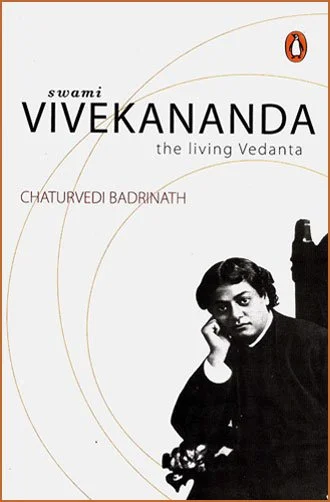
'You don't simply read a man like Vivekananda. In reading him, you meet him. And if you don't meet him and feel him contemporaneously, you can understand little of the meaning of what he is saying.' In the course of a short life of thirty-nine years, Swami Vivekananda came to be regarded as the patriot-saint of modern India.
Despite all that has been written about his life and his epoch-making address at the Parliament of Religions in Chicago, 1893, Swami Vivekananda remains a paradox: much is known about him, but very little is understood about the man and his relevance to our own troubled times. In Swami Vivekananda: The Living Vedanta, Chaturvedi Badrinath looks behind the iconic façade, seeking to liberate Vivekananda from the confines of the worship room. He examines the various facets of a man who was as much at ease with philosophical discourse as he was with cooking; whose childlike love for ice cream went hand in hand with his stature as a prophet.
The author also throws light on the various relationships that shaped Swamiji's philosophy of Vedanta and formed the core of his teaching-with his spiritual guru Sri Ramakrishna Paramahamsa, his mother Bhubaneswari Devi, and his many followers in the West, mostly women, who became central to his life and work. Well researched and brimming with a wealth of detail, Swami Vivekananda: The Living Vedanta offers an unforgettable insight into the life and times of this renaissance - figure one who was the very embodiment of the Vedanta that he preached.
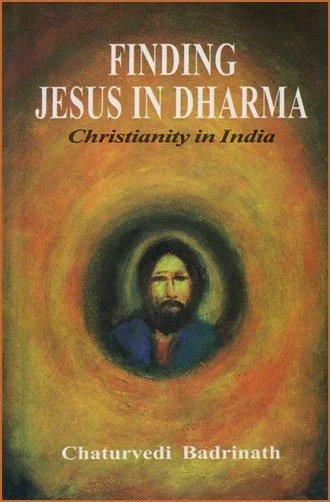
Christianity had flourished as an honoured faith in India, in Kerala, for four centuries before the nations of Europe began being Christianized. The Indian Christians have been an integral part of Indian society for as long as Christianity itself. They did not ever believe that there was any conflict between the spiritual environment in which they had their roots and their faith in Jesus Christ as Saviour. Christian missionaries from Europe and England many centuries later would insist that there was a radical breach between the two.
This book is about the history of the issues which western Christianity produced in its encounter with Dharmic civilisation. Missionaries were obliged to re-think Christianity in its relation to non-Christian religions, especially Hinduism. That story is narrated here mostly in the words of missionaries themselves. There is here also an account of Indian Christian thought: its concerns and direction. But above all, beyond history, beyond theology, there is Jesus, as the perfect embodiment of Dharma. Faith, trust, caring, love and truth-these are the meaning of Jesus, as they are of Dharma. In our troubled times, hearts would heal, and bring together what is falsely separated, making a journey towards both.

The key concept which will enable us to grasp the truth about India is the concept of Dharma. Dharma is that which sustains life and order in all their forms, cosmic, human, animal and divine. It is a secular concept in the sense that it arises from no alleged divine revelation but from a study of the human person in all the dimensions of human existence (which are certainly not merely material).
The concept of Dharma is not religious or anti-religious; it is secular. But, and here confusion begins to multiply even within India, the word Dharma has been used to embody the western concept of "religion". And therefore secularity has been understood to be anti-Dharmic. But the confusion originates in the West, where the concept of "religion" (from a Christian point of view, a very suspect concept) was used to explain what the invaders found in India.