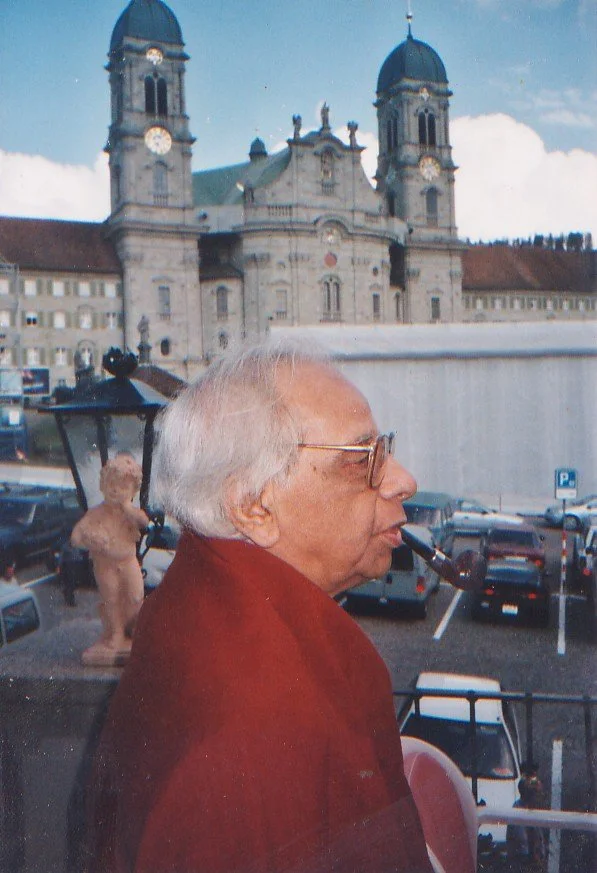
Badrinath was born in
Mainpuri, Uttar Pradesh in 1933. He studied at St. John's College, Agra, before taking his B.A. (Hons) degree in Psychology and Philosophy from Lucknow University in 1956. Admitted to the University College, University of London as a research student in Philosophy under Prof. A.J.Ayer, he interrupted his further studies to join the Indian Administrative Service, 1957-58 batch, and served in Tamil Nadu for thirty-one years (1958-89) based largely in Madras.
In 1965 and once more in 1970, he received invitations from the Government of the then Federal Republic of Germany to engage with contemporary academic discourse within German universities. During his tenure as Collector of Madras, he authored a detailed report on the urban development of Greater Madras. Subsequently, the United Kingdom Government extended an invitation for him to study advancements in the philosophy of local self-government in England.
He was a Homi Bhabha Fellow from 1971 to 1973.
As a Visiting Professor at Heidelberg University, 1971, he gave a series of four seminars on Dharma and its application to modern times. In 1973 he gave a lecture at Presidency College Madras on The Idea of History where he talked about the script of India's history buried in the Time Capsule, stating it was 'neither history nor fiction'. This led to a great furore over the issue, with angry debates held both in the Lok and Rajya Sabha.
In 1977 when his senior in the service remarked to the press that Badrinath was trying to 'sabotage the civil services from within' Badrinath went to court over the issue. Years of legal battle led finally to justice from the Supreme Court of India. The Supreme Court held in 1984 , with regard to rule 17 of the All India Services (Conduct) Rules, 1968, that "No member of the Service is prohibited from vindicating his private character or any act done by him in his private capacity."
Never a favourite of his seniors in the service, Badrinath was denied promotion to the super-time scale. This led to another court case, where he questioned the fairness and grounds of this denial. When the case reached the Supreme Court on appeal, Badrinath argued the case himself with the rock-solid legal support of Advocate Sanjay Parikh. In 2000, by which time he had taken voluntary retirement from the service, the Supreme Court of India held in favour of Badrinath . This precedent has been in cited in 36 other judgements so far.
Invited by a Swiss Foundation, Intercultural Cooperation, Zurich, he spent a year in Europe, 1985-1986, to work, in European environment, on his history of the Western encounter with Indian civilisation, which took place in the form of Western Christianity, Liberalism, modern scientific thought, and Marxism.
Badrinath was a Visiting Professor, 1990-1992, at the Centre for Policy Research, New Delhi. He moved from Madras to Gurgaon in 1989. He lived there for fifteen very productive years, during which time he worked on his books, wrote articles and gave many lectures both in India and abroad, before returning to the south.
In 2004, Chaturvedi Badrinath moved to Pondicherry where he built a house, Badri-la, in the 'mist of nowhere'. Although it was in a remote location, he was convinced this was a lucky house because three of his books were published after his arrival there, as was his daughter Tulsi's first novel, and he had begun work on his autobiography while living in Badri-la. He passed away in Pondicherry on the 17th of February 2010, a day after he was presented the Sahitya Akademi Award 2009 for his book on the Mahabharata.